World Alzheimer’s Month: The Connection Between Hearing and Brain Health
|
Every September, World Alzheimer’s Month encourages families and communities to learn more about Alzheimer’s disease, dementia, and the steps that may support lifelong cognitive health. Your hearing deserves a place in that conversation.
Have you started to find it harder to understand the higher-pitched voices of children or grandchildren? Do words seem to disappear when several people are talking at once?
These changes may feel small, but they can be signs that your brain is working harder to make sense of incomplete or unclear sound. Addressing those challenges helps you communicate more easily, remain socially connected, and support your cognitive wellness as you age.
How Hearing and Cognitive Health Are Connected
Hearing happens in the brain as well as the ears. Your ears collect sound, but your brain must identify and interpret that information. When hearing loss challenges make speech less clear, your brain may have to use more cognitive energy to fill in the missing pieces.
High-frequency sounds are often the first to become difficult to hear; you may still hear someone speaking but struggle to understand exactly what was said. That additional listening effort can be tiring and leave fewer mental resources available for remembering details or concentrating on another task at the same time.
Hearing challenges can also affect your social life. When conversations become frustrating, you may begin avoiding things like family gatherings or phone calls. Over time, this reduced social engagement can contribute to loneliness and isolation, which are recognized risk factors for cognitive decline.
What the WHO’s Updated Guidance Says
The World Health Organization (WHO) has released updated guidelines that formally include hearing care within its broader approach to reducing the risk of cognitive decline and dementia.
The guidelines state that hearing aids may be offered as part of a risk-reduction strategy for people experiencing hearing loss challenges, which places greater emphasis on acting after hearing challenges are identified to help prevent cognitive decline.
A comprehensive hearing evaluation can help you understand the type and extent of any hearing difficulties you may be experiencing and identify the support and treatment options that may be right for you.
Take Charge of Your Hearing Health This World Alzheimer’s Month
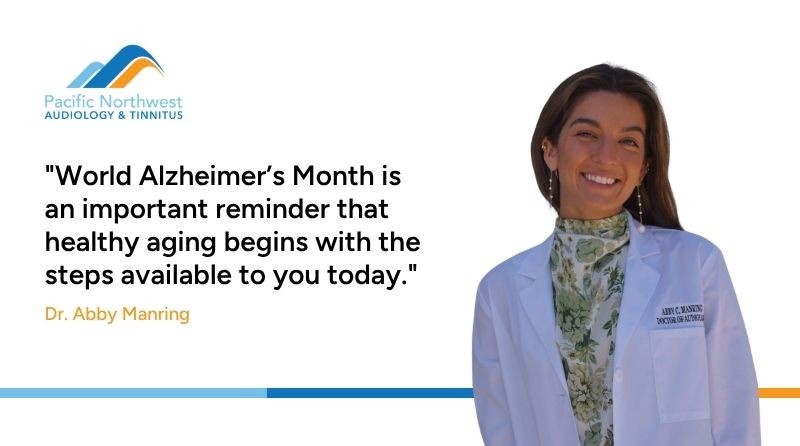
World Alzheimer’s Month is an important reminder that healthy aging begins with the steps available to you today. You cannot control every factor related to cognitive decline, but you can pay attention to changes in your hearing and seek professional guidance when conversations become more difficult.
Contact our team at Pacific Northwest Audiology to request a callback or schedule an appointment. Taking action early can help you understand your hearing needs and stay connected to the people and activities that matter most.
Frequently Asked Questions (FAQs)
Q: Do hearing challenges cause Alzheimer’s disease?
A: Evidence shows a connection between untreated hearing loss challenges and a higher risk of cognitive decline or dementia. However, this does not mean that changes to your hearing health directly cause Alzheimer’s disease.
If you are concerned about changes in your memory or behavior, speak with your primary care provider. A hearing evaluation can help determine whether difficulty hearing may also be affecting your conversations or communication.
Q: Can hearing aids prevent dementia?
A: Hearing aids cannot guarantee that dementia will be prevented, and they are not a treatment for Alzheimer’s disease. However, the updated WHO guidance says hearing aids may be offered as part of a risk-reduction strategy for people with hearing loss challenges.
When appropriately fitted, hearing aids can improve access to sound and speech. You may find it easier to participate in conversations and to maintain social connections, which can support your overall quality of life and cognitive wellness.
Q: When should I schedule a hearing evaluation?
A: Consider scheduling an evaluation if you frequently have difficulty understanding speech when there is background noise, struggle with higher-pitched voices, or feel unusually tired after conversations.
You can also benefit from an evaluation if family members have noticed changes in your hearing or if you would like a baseline assessment for future comparison. A comprehensive assessment can distinguish hearing loss from other concerns and provide clear recommendations that are tailored to you.
Sources
· World Health Organization: Risk reduction of cognitive decline and dementia, second edition